

The Search Bar Has Changed Forever
Not long ago, optimizing a website meant one thing: get Google to rank you higher. Write the right keywords, earn the right backlinks, and traffic would follow.
That model is cracking.
Today, a growing share of people never visit a search results page at all. They type a question into Perplexity, ChatGPT, Arc Search, or Google's AI Mode, and receive a synthesized, confident answer. No ranked list of ten blue links. No browsing. Just an answer, often drawn from sources the user never sees.
The numbers tell the story clearly. Zero-click Google searches jumped from 56% in 2024 to 69% in 2025. Adobe's research found that AI-driven web referrals grew more than 10x in the United States between July 2024 and February 2025. ChatGPT now serves 800 million users weekly. And Gartner predicts that by 2026, 25% of organic search traffic will shift to AI chatbots and virtual assistants.
The implication for anyone who builds websites is uncomfortable but simple: if an AI can't read your site, your site effectively doesn't exist. This is not hyperbole. It is a structural shift in how discovery works, and your design and development choices either help or hurt you in this new environment.
Why Classic Keyword SEO Is Dying
For three decades, SEO was largely about keywords. Stuff the right phrases into your headings, repeat them in your body copy, and engineer your page to match what crawlers expected. It worked, because traditional search engines indexed and ranked whole pages based largely on keyword frequency and backlink authority.
Large language models don't work that way. When an AI search engine processes your page, it isn't counting how many times you said "best running shoes." It is interpreting meaning, assessing credibility, and extracting facts it can confidently cite. Traditional crawlers index content; LLMs interpret and predict.
This is why keyword stuffing is not just ineffective in the AI era — it actively signals low quality. A page bloated with repeated phrases, thin paragraphs, and no clear structure looks incoherent to a machine trying to understand it. It gets skipped in favor of sources that communicate clearly.
What AI systems actually reward is semantic clarity, meaning content that unambiguously answers specific questions. They reward topical authority, which is deep and consistent expertise on a subject. They look for entity richness, with clear identification of who, what, where, and when. And they favor structural integrity, meaning a logical hierarchy that machines can parse. The new gold standard isn't keyword density. It's precision and structure.
The Modern Irony: Beautiful Websites That Are Invisible
Here is where things get paradoxical for designers and developers. The most visually impressive websites of the past decade — full-screen video backgrounds, immersive 3D scroll experiences, animated SVGs, content locked inside canvas elements — are often the worst performers in AI search.
Why? Because AI crawlers see HTML and text. They don't execute complex JavaScript to reveal hidden content. They can't extract meaning from a WebGL scene or a CSS animation. If your hero section is a video with no text alternative, the AI sees nothing. If your product descriptions live inside a JavaScript-rendered carousel, the AI may see nothing. If your About page is a full-bleed image with text baked into it, the AI definitely sees nothing.
Perplexity, which has been more transparent than most about its architecture, uses sub-document processing — indexing granular snippets rather than full pages. When you query it, the system retrieves roughly 130,000 tokens of the most relevant text snippets. Snippets that don't exist in plain text can't be retrieved. No text, no citation.
This is the modern irony of web design: the more aggressively you push visuals over text, the more invisible you become to the systems increasingly driving discovery. JavaScript-heavy pages compound the problem. Many AI-driven bots time out or struggle to render complex JavaScript. A slow-loading or JS-dependent page is frequently skipped, not penalized, simply invisible.
What AI Crawlers Actually See
It helps to think about what happens when an AI crawler visits your page. It fetches the raw HTML. It parses the DOM, reading headings, paragraphs, links, and semantic tags. It reads any structured data in the page head. It then attempts to extract entities: people, organizations, products, dates, and locations. It evaluates whether those entities are clearly identified, internally consistent, and cross-referenceable with other trusted sources. Finally, it decides whether your page is a credible, citable source for a specific question.
At every step, ambiguity and complexity are the enemy. The cleaner, the more explicit, the more structured your page is, the better.
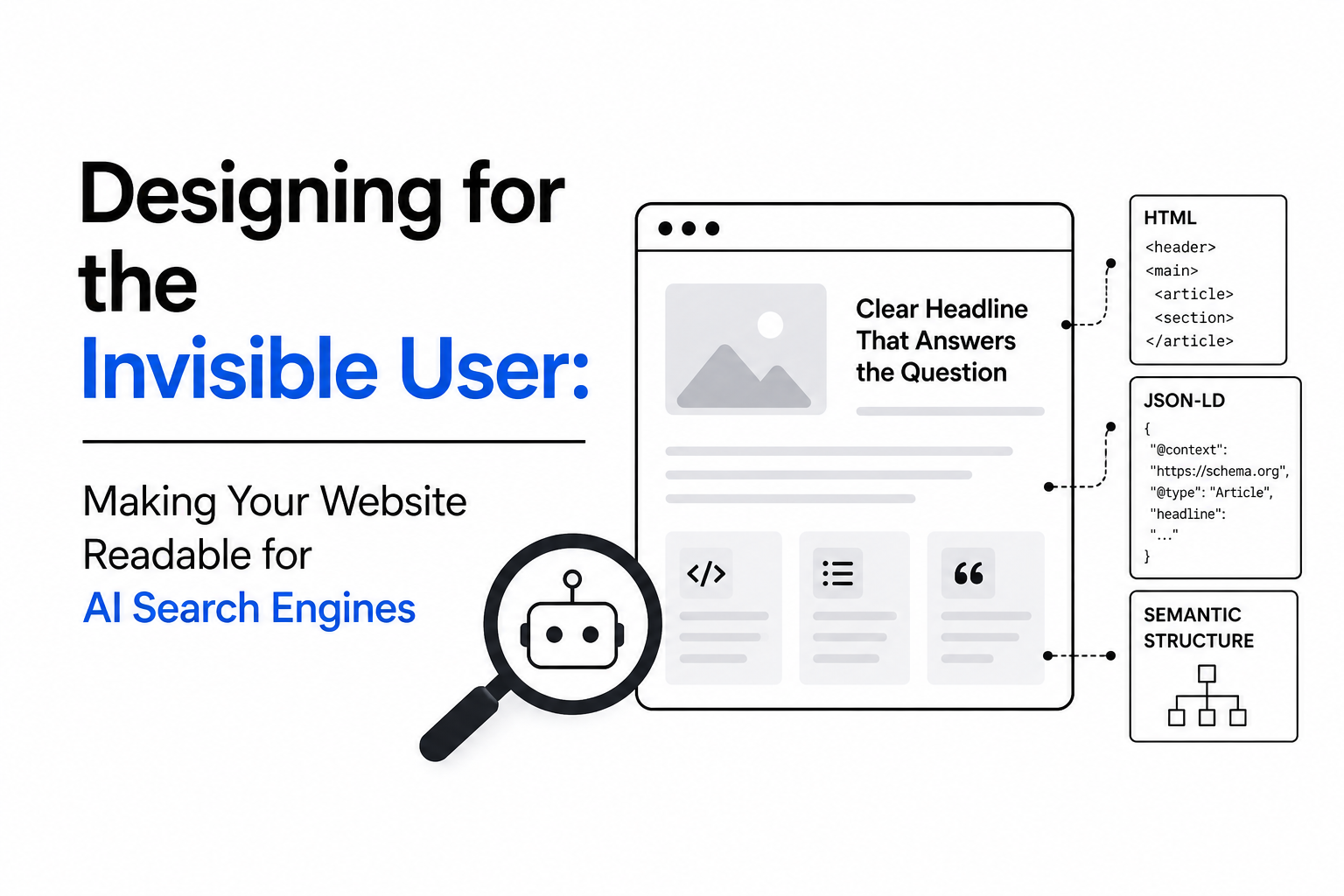
Semantic HTML: Write Code That Means Something
HTML tags were always supposed to carry meaning. The article tag means an article. The nav tag means navigation. The h1 tag means the primary heading. In practice, many developers defaulted to divs and spans for everything, relying on CSS classes to create visual structure.
AI crawlers care about the semantic layer, not the visual one. A page built entirely with div wrappers gives a crawler almost no information about what each section means or how content relates to other content.
Practical steps include using one h1 per page for your primary topic, creating a logical hierarchy with h2 down through h4, wrapping standalone content in article tags, marking navigation with nav, and using the main tag for the primary content area. Use aside for supplementary information, and use figure and figcaption for images with descriptions. Never skip heading levels — a crawler follows the hierarchy like a table of contents.
Google's own documentation acknowledges that using semantic HTML helps other types of users, such as screen readers, parse and navigate web pages more easily. The overlap between accessibility and AI readability is not a coincidence. Both rely on semantic meaning, not visual presentation.
Structured Data: Give Machines a Map
Semantic HTML tells the crawler what kind of content exists. Schema markup tells it what that content actually means.
Schema.org is a shared vocabulary created in 2011 by Google, Microsoft, Yahoo, and Yandex. It gives web publishers a standardized way to describe content in machine-readable terms. Instead of a crawler inferring that "999.00" on a product page is probably a price, schema markup explicitly declares: this is a Product, with an Offer, at a price of 999.00 in USD, currently in stock.
Microsoft's Bing principal product manager confirmed in March 2025 that schema markup helps Microsoft's LLMs understand content. Google's documentation recommends it explicitly for AI features. Tests from October 2025 confirmed that ChatGPT, Claude, Perplexity, and Gemini all actively process schema when directly accessing content.
The preferred format is JSON-LD, a block of structured data in a script tag in your page head, completely separate from your visible HTML. AI crawlers can parse JSON-LD without having to untangle it from your design markup. It's cleaner, faster, and less error-prone.
The most impactful schema types are Organization for brand identity and contact info, Article or BlogPosting for content pages with author and date, FAQPage for question-and-answer blocks, HowTo for step-by-step guides, Product combined with Offer for e-commerce pages, Person for author or team member profiles, and BreadcrumbList for navigation hierarchy.
A FAQPage schema block pre-packages your content in exactly the question-and-answer format LLMs reach for when generating responses. It is one of the highest-leverage schema types you can implement.
One important caveat: schema alone is not a magic switch. A December 2024 study found no correlation between schema coverage and citation rates in isolation. What matters is schema combined with genuinely authoritative, clearly structured content. Schema amplifies quality — it doesn't substitute for it.
Content Architecture: Write for How Machines Retrieve
AI systems like Perplexity index at the sub-document level, not the whole page, but specific snippets. This means your content architecture matters at the paragraph level, not just the page level.
Use one idea per paragraph. Each block of text should answer one specific question or cover a single concept. Avoid blending two topics in the same paragraph, as it confuses extraction. Lead with the answer: state the core point in the first sentence, then elaborate. This is how featured snippets are extracted, and it is also how AI systems identify citable passages.
Use clear, descriptive headings. Your h2 and h3 tags should function as standalone questions or declarative statements. "What Is Semantic HTML?" is more extractable than "A Quick Note." Include explicit definitions: if you introduce a concept, define it clearly and concisely in the same section. AI systems look for definitional clarity when generating authoritative answers. Use tables and lists deliberately, since structured formats are highly extractable and signal to machines that discrete, comparable facts exist on your page.
JavaScript: Use It, But Don't Hide Content Inside It
JavaScript is not your enemy. But hiding critical content inside JavaScript that only renders after page load is.
Many AI crawlers don't execute JavaScript, or they time out before it finishes rendering. If your product descriptions, FAQs, or key landing page copy only appear after a JS framework hydrates the page, a significant portion of AI crawlers may never see it.
The rule is to keep critical informational content in raw HTML. Use JavaScript for interactivity and enhancement, not for delivering primary content. In Next.js or any React framework, this means preferring server-side rendering or static site generation for content pages, so the HTML that crawlers receive already contains the text, not a loading skeleton waiting for client-side JavaScript to fill it.
Balancing Design and Machine Readability
The question designers are really asking is: do I have to choose between beautiful and machine-readable? The answer is no, but it requires understanding the separation of layers.
Think of your website in three layers. The presentation layer is how it looks: CSS, animations, visual design. The content layer is what it says: HTML text, headings, paragraphs. The semantic layer is what it means: schema markup, semantic tags, alt text.
You can make the presentation layer as visually rich as you want, provided the content and semantic layers remain intact underneath. A full-bleed hero image can coexist with an h1 headline that the crawler reads. A three-column animated card grid can coexist with server-rendered text inside each card. A minimalist portfolio site can coexist with Organization schema describing who you are.
Practical design decisions that preserve machine readability include using CSS for visual effects, not for hiding or replacing text. Always write alt text for images, not "image1.jpg" but a descriptive sentence. For icon-only navigation, add aria-label or visually hidden text for screen readers and crawlers. When using video or canvas backgrounds, place an h1 and descriptive paragraph in the HTML alongside them. Prefer text overlaid on images using CSS over text baked into images. Avoid display:none on content you want indexed.
What About llms.txt?
You may have seen discussion of a proposed standard called llms.txt, a plain-text file at your domain root that curates key URLs and content for AI crawlers, analogous to robots.txt.
As of mid-2026, the honest assessment is that it's experimental and niche. Only around 784 documented implementations existed as of late 2025, concentrated almost entirely in AI companies, developer tools, and SaaS platforms. No major LLM search engine has officially announced support for the protocol, and studies found no measurable correlation between having an llms.txt file and AI citation frequency.
More importantly, Google's official documentation explicitly states you don't need to create special machine-readable files or AI text files to appear in Google's generative AI features. For now, focus on fundamentals rather than experimental protocols.
E-E-A-T: The Trust Layer AI Systems Rely On
Beyond technical structure, AI systems evaluate trustworthiness. Google's E-E-A-T framework, which stands for Experience, Expertise, Authoritativeness, and Trustworthiness, applies as much to AI search as to traditional rankings.
AI systems cross-reference your content against other trusted sources. A page that contradicts established facts, lacks author attribution, or has no external links pointing to it is less likely to be cited.
Signals that build E-E-A-T for AI include named authors with schema markup linking to their professional profiles on LinkedIn or Google Scholar. Include publication and update dates in both visible content and schema using the datePublished and dateModified fields. Use sameAs links in your Organization schema pointing to verified profiles on Wikipedia, Wikidata, or Crunchbase. Maintain consistent factual accuracy with other authoritative sources, and work toward having external sites cite or link to your content.
The sameAs schema property deserves special attention. By linking your Organization entity to your verified profiles on external platforms, you give AI crawlers independent anchors to cross-reference your identity. This directly reduces the ambiguity that leads to hallucinations or non-citation.
Measuring Success in the AI Era
Traditional SEO success was measured by keyword rankings and organic click-through rates. In the AI era, those metrics are still relevant but they tell an incomplete story.
A Brightedge study found that 52% of AI Overview citations came from URLs already ranking in the top 10 organic positions. So traditional SEO and AI visibility are not separate races. Strong SEO still feeds into AI citation. But you also need new signals.
What to track includes your presence in Google AI Overviews, which is visible in Search Console impression data. Track brand mentions in AI tools using tools like Profound, Otterly.ai, or OmniSEO across platforms. Watch for zero-click impressions, where high impressions with low clicks often indicate AI extraction. And test citation frequency in Perplexity and ChatGPT search responses using manual testing combined with specialized tools.
A Practical Checklist for AI-Ready Web Design
For content: each page should have one clear primary question it answers, and that answer should be stated in the first paragraph. Headings should form a logical, skip-free hierarchy from H1 through H2 through H3. Each paragraph should cover one idea. Images should have descriptive alt text written as full sentences, not filenames.
For technical HTML: use semantic HTML elements such as article, nav, main, section, and aside. Use one h1 per page. Ensure critical content is in server-rendered HTML, not JavaScript-only.
For structured data: add Organization schema on the homepage with sameAs links, logo, and contact information. Add Article or BlogPosting schema on content pages with author and dates. Add FAQPage schema on any page with question-and-answer content. Add Product schema on product pages with Offer, pricing, and availability. Validate all schema with the Google Rich Results Test.
For performance: aim for page loads under 3 seconds, ensure Core Web Vitals pass, and eliminate render-blocking resources on critical content.
For trust: name and link to authors, mark publication and update dates in both HTML and schema, include external links to authoritative sources where relevant, and add sameAs links in your Organization schema.
The Mindset Shift
The designers and developers who will thrive in this environment are not those who treat AI readability as a separate compliance task bolted on after the real design work is done. They are those who understand that clean structure is good design.
Semantic HTML is not bureaucratic overhead. It is how your content communicates its meaning to anything that reads it, human or machine, sighted or not. Structured data is not arcane code. It is the translation layer between your expertise and the systems distributing that expertise.
The paradox resolves when you understand it clearly: a minimalist, elegant visual experience for humans and a rich, explicit semantic layer for machines are not in tension. They occupy different layers of the same page. You can have both.
What you cannot have is visual richness at the expense of the content and structure layer. That is the trade-off that makes beautiful websites invisible.
Design for the human eye. Build for the machine mind. Both matter now.